

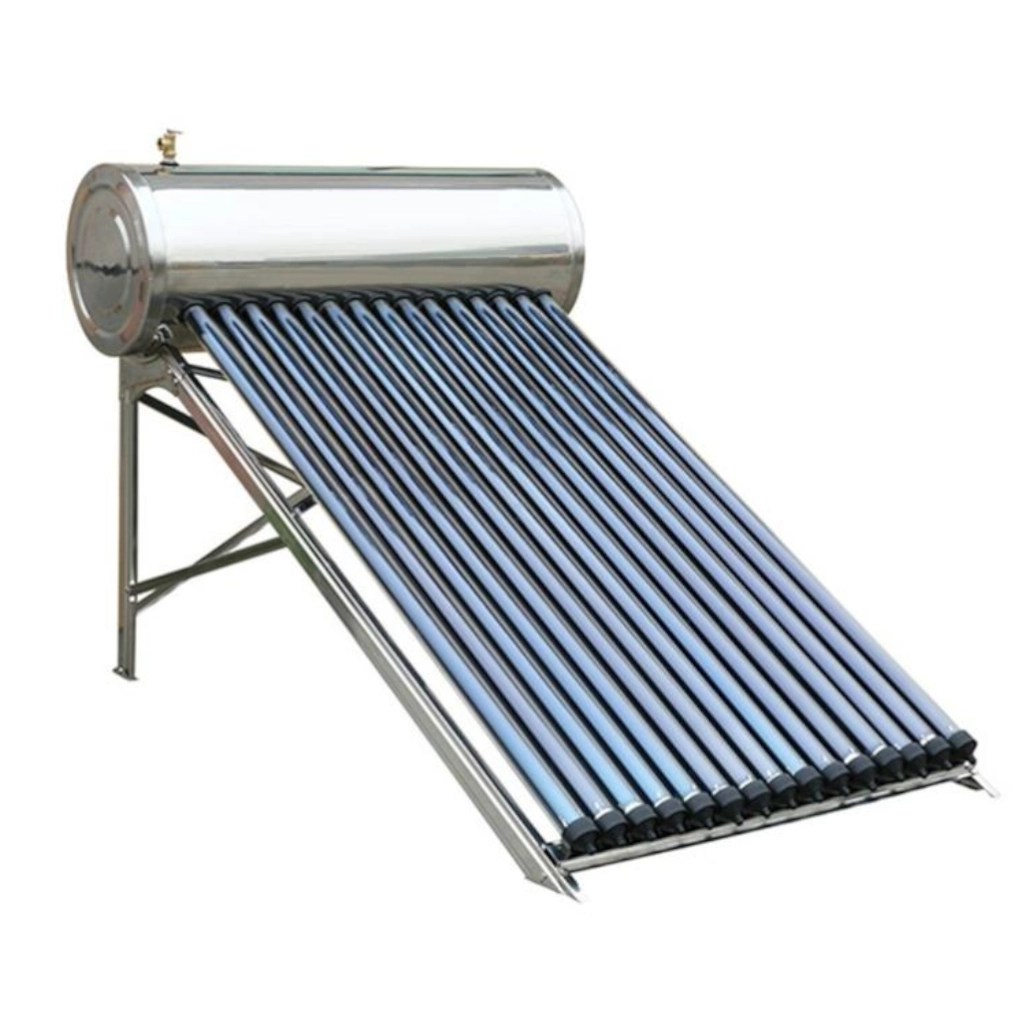

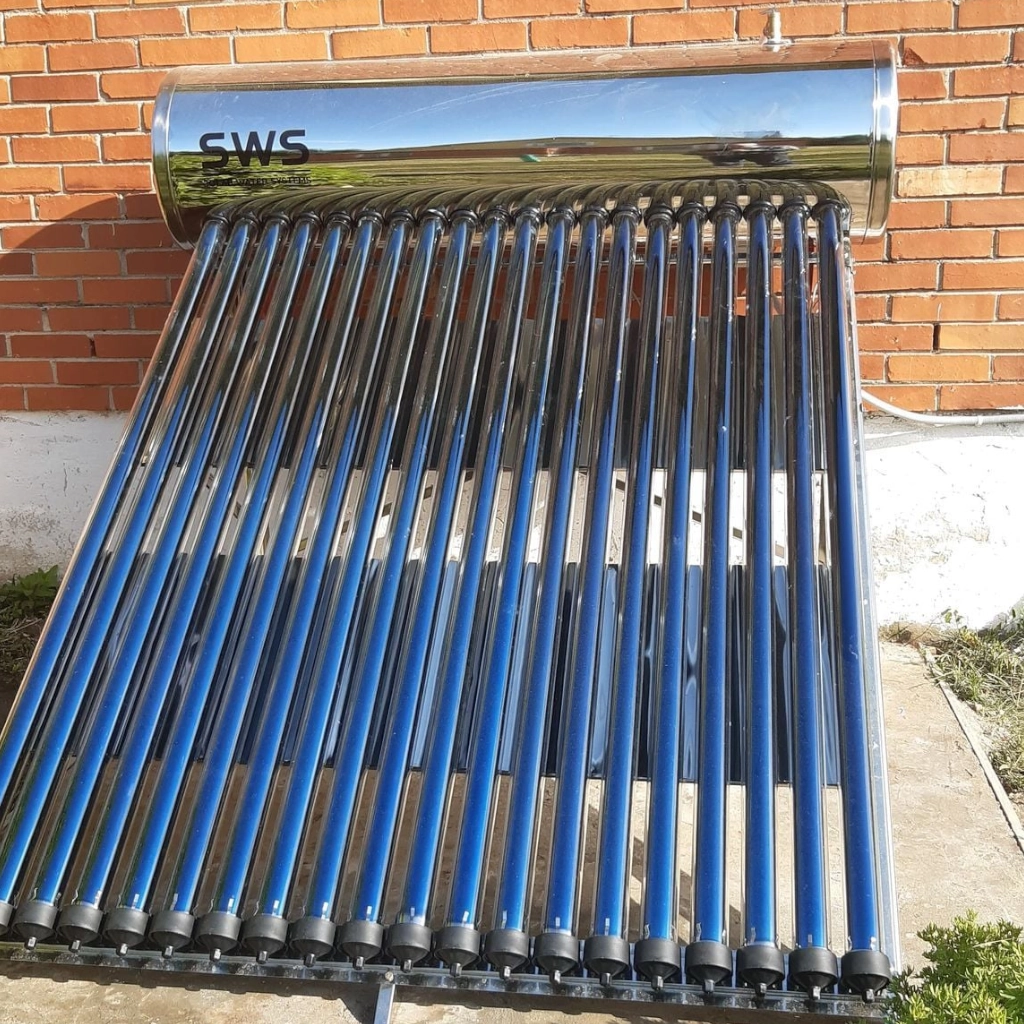

Pressure collector SWS-CPS
(solar water pressure heater)
Pressure collector SWS-CPS
(solar water pressure heater)
Operating principle

Diagram of operation of a pressure solar collector.
—
1. Cold water.
2. Hot water.
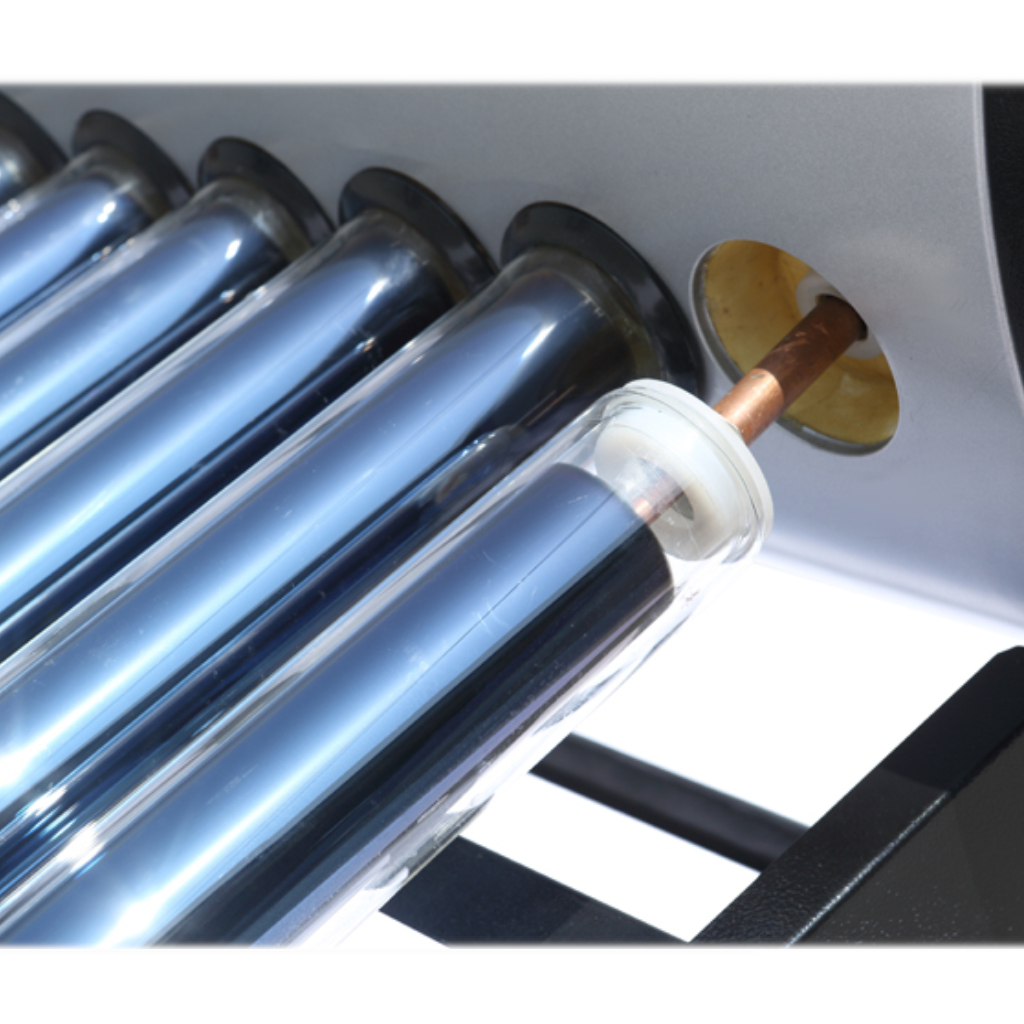
3. Vacuum glass flask.
4. Copper heat-pipe, which can heat up to 200°C.
5. Insulating water tank layer that retains heat for up to 72 hours.
Operating principle
Diagram of operation of a pressure solar collector.
—
1. Cold water.
2. Hot water.
3. Vacuum glass flask.
4. Copper heat-pipe, which can heat up to 200°C.
5. Insulating water tank layer that retains heat for up to 72 hours.
How to choose a collector size?
We recommend choosing the size of the solar collector according to your individual warm water consumption needs. However, it is always advisable to choose a
  | 150 | 15 |
 | 200 | 20 |
 | 300 | 30 |
* The number of family members given is for guidance only.
How to choose a collector size?
We recommend choosing the size of the solar collector according to your individual warm water consumption needs. However, it is always advisable to choose a
| 150 | 15 |
| 200 | 20 |
| 300 | 30 |
* The number of family members given is for guidance only.
Mounting
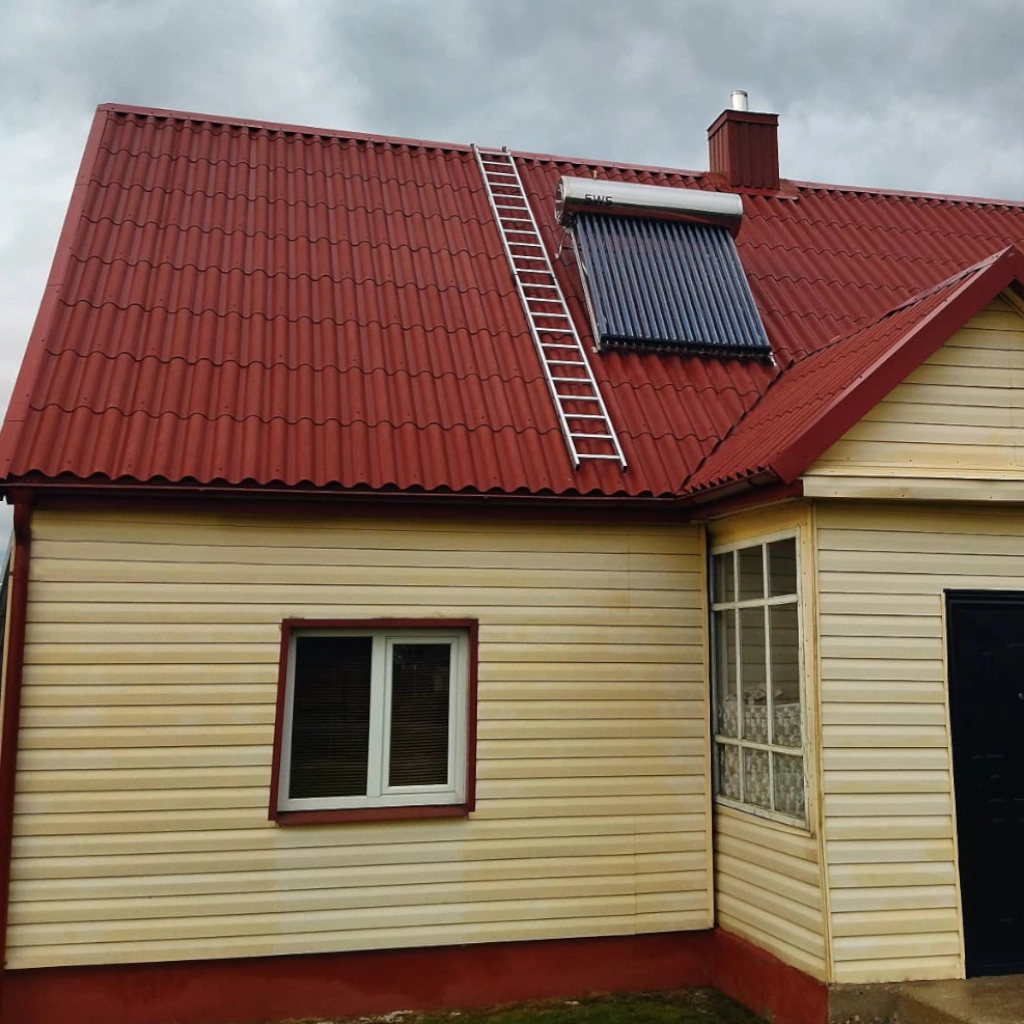
The pressure solar collector can be mounted both on the ground and on the roof (horizontal or sloping). It can also be mounted on a vertical surface (wall) with an additional frame. The

Ground/horizontal and pitched roof installation options.
Mounting
The pressure solar collector can be mounted both on the ground and on the roof (horizontal or sloping). It can also be mounted on a vertical surface (wall) with an additional frame. The
Ground/horizontal and pitched roof installation options.
Connection to the water supply
The pressure solar collector with integrated water tank
Installation and connection of this unit to the water supply is simpler than a non-pressurized heater, as the water pressure in the tank is the same as in the water supply system – the water supply is connected directly to the water tap of the heater (without any refill tanks or electric valves).
Connect directly to the mixer
The hot water coming out of the solar water heater can be used directly by connecting it directly to the faucet.
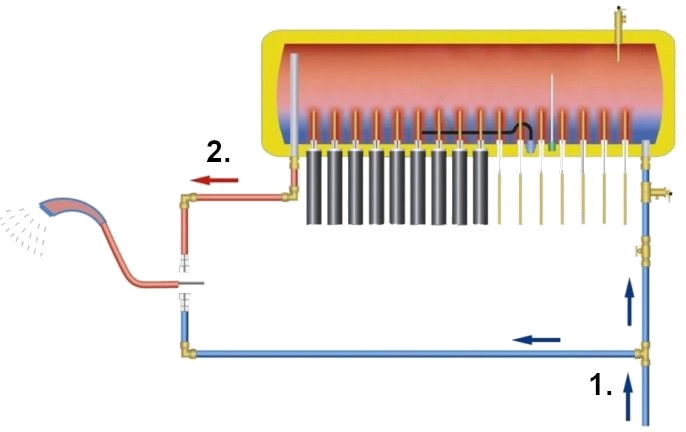
—
1. Cold water.
2. Hot water.
Connection via electric or gas heater
The hot water from a solar water heater can be connected to a gas water heater or an electric boiler, so that your gas or electric boiler will run at a lower load and use less energy by heating the water that has already been heated by the sun.
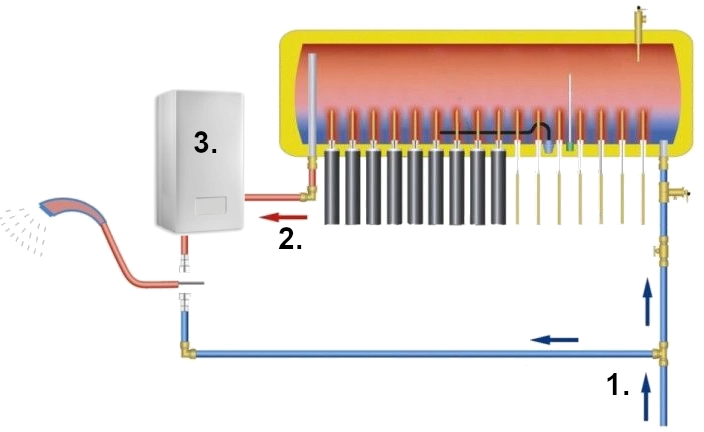
—
1. Cold water.
2. Hot water.
3. Electric boiler or gas heater.
Connection to the water supply
The pressure solar collector with integrated water tank
Installation and connection of this unit to the water supply is simpler than a non-pressurized heater, as the water pressure in the tank is the same as in the water supply system – the water supply is connected directly to the water tap of the heater (without any refill tanks or electric valves).
Connect directly to the mixer
The hot water coming out of the solar water heater can be used directly by connecting it directly to the faucet.
—
1. Cold water.
2. Hot water.
Connection via electric or gas heater
The hot water from a solar water heater can be connected to a gas water heater or an electric boiler, so that your gas or electric boiler will run at a lower load and use less energy by heating the water that has already been heated by the sun.
—
1. Cold water.
2. Hot water.
3. Electric boiler or gas heater.
Winter use ❄️
The pressurized solar collector also works during the cold season, but the amount of energy absorbed is significantly lower. During the winter, solar energy is usually only enough to keep the system warm, which is needed to protect it from freezing. The unit can only be operated in winter if the unit is supplied with an electronic controller with an integrated electric heater and the unit is permanently connected to the mains. When the water temperature drops to a critical level, the electric heater in the unit additionally heats the water and protects it from freezing. This is relevant when the outdoor temperature is extremely low for a longer period of time, it is cloudy or the vacuum flasks of the solar collector are snowy and do not receive direct sunlight. It is also very important to insulate the plumbing well.
Note
Winter use ❄️
The pressurized solar collector also works during the cold season, but the amount of energy absorbed is significantly lower. During the winter, solar energy is usually only enough to keep the system warm, which is needed to protect it from freezing. The unit can only be operated in winter if the unit is supplied with an electronic controller with an integrated electric heater and the unit is permanently connected to the mains. When the water temperature drops to a critical level, the electric heater in the unit additionally heats the water and protects it from freezing. This is relevant when the outdoor temperature is extremely low for a longer period of time, it is cloudy or the vacuum flasks of the solar collector are snowy and do not receive direct sunlight. It is also very important to insulate the plumbing well.
Note
technical specifications
| Model | SWS-CPS-150 | SWS-CPS-200 | SWS-CPS-300 |
| Capacity volume | 150 l | 200 l | 300 l |
| Number of vacuum flasks | 15 | 20 | 30 |
| Absorption area | 1.57 m 2 | 2.09 m 2 | 3.13 m 2 |
| Weight | 88 kg | 110 kg | 180 kg |
Hot water storage capacity
| Inner container material | Stainless steel SUS304-2B; 1.2 mm thick |
| Working pressure | 6 bars |
| Testing and maximum pressure | 10 bars |
| Daily hot water temperature | 45-90 ° C |
| Thermal insulation | Polyurethane foam, 50 mm |
| Heat retention | 72 hours |
| Outer material of the container | Stainless steel SUS 201; 0.35 mm thick |
| Frame | Stainless Steel |
| T / P valve | 6 bars; 95 ° C; 3 / 4ˮ |
| Water inlets and outlets | 1 / 2ˮ |
| Magnesium rod | 3 / 4ˮ, integrated |
| Electrical heater | 1ˮ; 1500 W; 220 V |
| Widget | SR609C |
Vacuum heat-pipe flask
| Dimensions of the glass flask | Ø58 mm x 1800 mm |
| Glass type | Three target |
| Vacuum | P<0,005 Pa{{{wpml_tag_663}}} {{{wpml_tag_664}}} {{{wpml_tag_665}}} {{{wpml_tag_666}}}Saulės energijos absorbcijos (sugėrimo) lygis{{{wpml_tag_667}}} {{{wpml_tag_668}}}> 93% |
| Heat loss | <0,8 W/m{{{wpml_tag_676}}}2{{{wpml_tag_677}}}{{{wpml_tag_678}}} {{{wpml_tag_679}}} {{{wpml_tag_680}}} {{{wpml_tag_681}}}Šiluminis vamzdelis{{{wpml_tag_682}}} {{{wpml_tag_683}}}Tu1{{{wpml_tag_684}}} {{{wpml_tag_685}}} {{{wpml_tag_686}}} {{{wpml_tag_687}}}Šiluminio vamzdelio kondensatoriaus matmenys{{{wpml_tag_688}}} {{{wpml_tag_689}}}Φ 14 mm * 6 mm{{{wpml_tag_690}}} {{{wpml_tag_691}}} {{{wpml_tag_692}}} {{{wpml_tag_693}}}Šiluminio vamzdelio kondensatoriaus stagnacijos temperatūra{{{wpml_tag_694}}} {{{wpml_tag_695}}}230 °C{{{wpml_tag_696}}} {{{wpml_tag_697}}} {{{wpml_tag_698}}} {{{wpml_tag_699}}}Šiluminio vamzdelio apsaugos nuo užšalimo temperatūra{{{wpml_tag_700}}} {{{wpml_tag_701}}}-40 °C{{{wpml_tag_702}}} {{{wpml_tag_703}}} {{{wpml_tag_704}}} {{{wpml_tag_705}}}Maksimali vėjo apkrova{{{wpml_tag_706}}} {{{wpml_tag_707}}}30 m/s{{{wpml_tag_708}}} {{{wpml_tag_709}}} {{{wpml_tag_710}}} {{{wpml_tag_711}}}Atsparumas krušai{{{wpml_tag_712}}} {{{wpml_tag_713}}}25 mm{{{wpml_tag_714}}} {{{wpml_tag_715}}} {{{wpml_tag_716}}} {{{wpml_tag_717}}}Eksploatavimo trukmė{{{wpml_tag_718}}} {{{wpml_tag_719}}}> 15 years |
technical specifications
| Model | CPS-150 | CPS-200 | CPS-300 |
| Capacity volume | 150 l | 200 l | 300 l |
| Number of vacuum flasks | 15 | 20 | 30 |
| Absorption area | 1.57 m 2 | 2.09 m 2 | 3.13 m 2 |
| Weight | 88 kg | 110 kg | 180 kg |
Hot water storage capacity
| Inner container material | Stainless steel SUS304-2B; 1.2 mm thick |
| Working pressure | 6 bars |
| Testing and maximum pressure | 10 bars |
| Daily hot water temperature | 45-90 ° C |
| Thermal insulation | Polyurethane foam, 50 mm |
| Heat retention | 72 hours |
| Outer material of the container | Stainless steel SUS 201; 0.35 mm thick |
| Frame | Stainless Steel |
| T / P valve | 6 bars; 95 ° C; 3 / 4ˮ |
| Water inlets and outlets | 1 / 2ˮ |
| Magnesium rod | 3 / 4ˮ, integrated |
| Electrical heater | 1ˮ; 1500 W; 220 V |
| Widget | SR609C |
Vacuum heat-pipe flask
| Dimensions of the glass flask | Ø58 mm x 1800 mm |
| Glass type | Three target |
| Vacuum | P<0,005 Pa{{{wpml_tag_918}}} {{{wpml_tag_919}}} {{{wpml_tag_920}}} {{{wpml_tag_921}}}Saulės energijos absorbcijos (sugėrimo) lygis{{{wpml_tag_922}}} {{{wpml_tag_923}}}> 93% |
| Heat loss | <0,8 W/m{{{wpml_tag_931}}}2{{{wpml_tag_932}}}{{{wpml_tag_933}}} {{{wpml_tag_934}}} {{{wpml_tag_935}}} {{{wpml_tag_936}}}Šiluminis vamzdelis{{{wpml_tag_937}}} {{{wpml_tag_938}}}Tu1{{{wpml_tag_939}}} {{{wpml_tag_940}}} {{{wpml_tag_941}}} {{{wpml_tag_942}}}Šiluminio vamzdelio kondensatoriaus matmenys{{{wpml_tag_943}}} {{{wpml_tag_944}}}Φ 14 mm * 6 mm{{{wpml_tag_945}}} {{{wpml_tag_946}}} {{{wpml_tag_947}}} {{{wpml_tag_948}}}Šiluminio vamzdelio kondensatoriaus stagnacijos temperatūra{{{wpml_tag_949}}} {{{wpml_tag_950}}}230 °C{{{wpml_tag_951}}} {{{wpml_tag_952}}} {{{wpml_tag_953}}} {{{wpml_tag_954}}}Šiluminio vamzdelio apsaugos nuo užšalimo temperatūra{{{wpml_tag_955}}} {{{wpml_tag_956}}}-40 °C{{{wpml_tag_957}}} {{{wpml_tag_958}}} {{{wpml_tag_959}}} {{{wpml_tag_960}}}Maksimali vėjo apkrova{{{wpml_tag_961}}} {{{wpml_tag_962}}}30 m/s{{{wpml_tag_963}}} {{{wpml_tag_964}}} {{{wpml_tag_965}}} {{{wpml_tag_966}}}Atsparumas krušai{{{wpml_tag_967}}} {{{wpml_tag_968}}}25 mm{{{wpml_tag_969}}} {{{wpml_tag_970}}} {{{wpml_tag_971}}} {{{wpml_tag_972}}}Eksploatavimo trukmė{{{wpml_tag_973}}} {{{wpml_tag_974}}}> 15 years |
More information about solar panels and solar water heaters



















Atsiliepimai
Atsiliepimų dar nėra.